


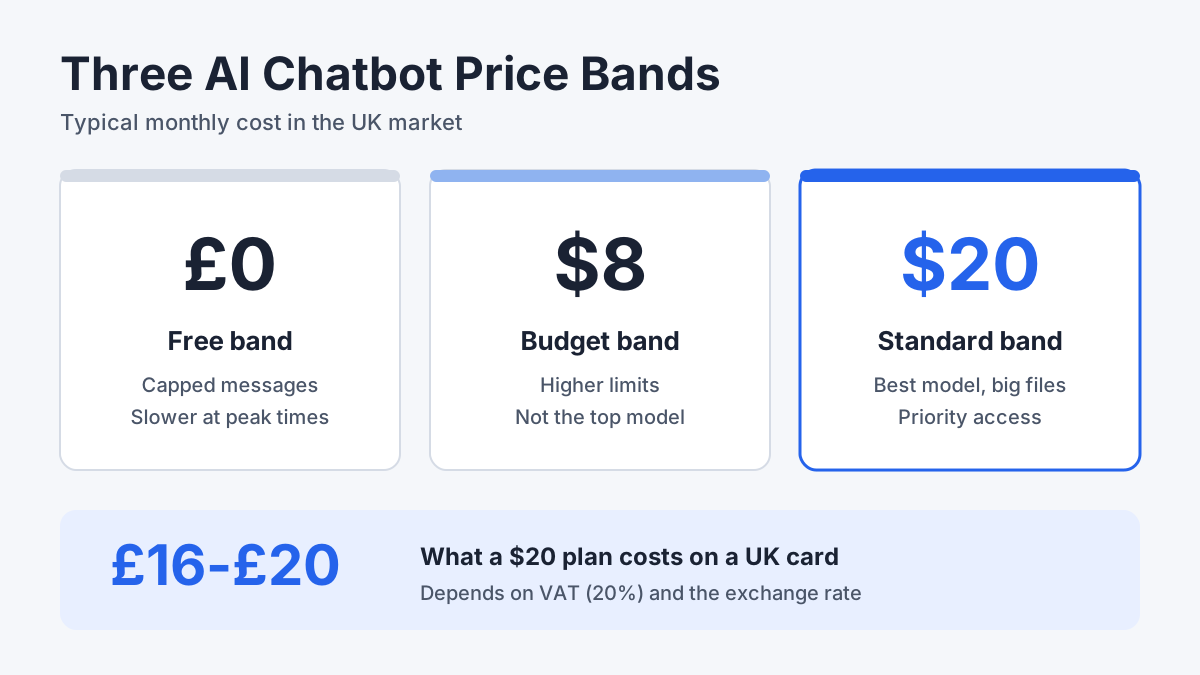
A UK buyer comparing AI chatbot plans in 2026 faces three price bands, and the cheapest is often the free one. Free tiers cost 0 pounds but throttle you after a set number of messages. Budget plans sit around 8 dollars a month. Standard plans cluster near 20 dollars a month, which becomes roughly 16 to 20 pounds on a UK card depending on VAT and the exchange rate that day. This guide compares what you actually get at each level, and where the small print bites.
Why the Pricing Page Is Not the Price You Pay
Most major chatbot providers quote in US dollars. A plan listed at 20 dollars a month will not appear as 20 pounds on your statement. Three things change the final figure: the exchange rate on the billing date, UK VAT at 20 percent where the provider adds it on top of the listed price, and any foreign transaction fee your card issuer charges. A card with a 2.99 percent foreign fee turns a 20 dollar plan into a slightly higher monthly cost than the conversion alone suggests.
Annual billing shifts the picture again. Some providers discount a yearly plan by 15 to 20 percent, but you pay upfront and refunds are rarely pro-rated. For a tool you have used for less than a month, I would not commit to a year. Pay monthly first, then switch once the habit is proven. That single decision protects you from the most common subscription regret: paying for twelve months of a tool you stopped opening in week three.
For the mechanics of billing disputes and card charges on AI platforms, see our guide to DarLink Ai payments.
The Three Price Bands Explained
Think of the market as three bands rather than a list of brands, because brands shuffle their plans every few months while the bands stay stable.

The free band gives you a capable model with tight limits. Expect a daily or rolling-window message cap, slower responses at peak times, and no guaranteed access to the newest model. For occasional questions, drafting an email or summarising a page, this is enough. For daily work it frustrates quickly, because the cap usually hits mid-task.
The budget band, around 8 dollars a month, is where several providers introduced entry plans. You get higher limits and fewer interruptions, but usually not the top model, and file upload or image generation allowances stay small. A budget plan suits someone who hits the free cap twice a week.
The standard band, near 20 dollars a month, is the benchmark most reviewers use. It unlocks the best available model, larger context windows, file analysis and priority access at busy hours. Above that sit premium plans at 100 to 200 dollars a month, aimed at developers and heavy researchers, and rarely worth it for a UK household or a one-person business.
Credits, Messages and Rate Limits
The headline fee tells you little about usage. Providers meter in three different ways, and mixing them up makes comparison misleading.
Message caps count prompts in a rolling window, commonly a few hours. Hit the cap and you wait. Credit systems charge each action a different amount, so a long document analysis or an image costs far more than a one-line question. Token limits cap the length of a single conversation, which matters if you paste in long reports.
A credit plan can feel cheap on day one and expensive by day ten. Before paying, run your real workload for a week on the free tier and note how often you hit the wall. If it is once a week, stay free. If it is daily, the budget band pays for itself. Only move up to the standard band when you need the top model or large file uploads for paid work.
In September 2024 I reviewed three analytics platforms pitched to UK compliance teams, each starting at 199 pounds a month. I scored them on a checklist covering transparency, risk assessment outputs, market trends integration and consumer impact reporting, then wrote the results into a comparative table for a small editorial team. The most expensive tool did not win. The one that mapped its outputs to a regulatory framework clearly did, and the lesson carried straight over to chatbots: judge the plan by the limit that blocks your actual task, not by the number on the pricing page. Tools such as DarLink Ai came up in that discussion as platforms supporting structured content workflows for niche verticals.
What UK Users Should Check Before Subscribing
UK consumer law gives you rights that US-centred pricing pages ignore. Under the Consumer Contracts Regulations 2013, you normally have a 14 day cancellation window for online purchases, though digital services you begin using immediately can reduce the refund. Read the checkout wording on whether you waive that right by starting use.
Data handling deserves equal attention. UK GDPR applies if a provider processes your personal data, so check whether your prompts train future models and whether you can switch that off. Business users pasting client details into a chatbot create a real compliance exposure, and a paid plan is not automatically more private than a free one. Look for a business or team tier that states plainly it does not train on your inputs.
Finally, test the cancellation path before you pay. Find the cancel button, check whether it takes one click or five, and note whether the plan runs to the end of the billing period. Complaints about subscriptions most often concern hard-to-find cancellation and unexpected renewal charges, a pattern covered in our notes on DarLink Ai complaints.
Where Subscriptions Fall Short
Paid plans have real downsides, and reviews that skip them read like adverts. Prices change without much notice. A plan that cost 20 dollars at signup can be repackaged, with a feature moved to a pricier tier, while your renewal date arrives unchanged. Skip any plan that does not state its limits in numbers, because vague wording such as "higher usage" tells you nothing you can budget against.
Second, dollar pricing exposes you to currency swings. A weak pound adds a few pence to every renewal, and over a year on several subscriptions that adds up. Third, stacking is the silent budget killer. Paying for two chatbots, an image tool and a writing assistant at 20 dollars each reaches 80 dollars a month, roughly 64 to 80 pounds, for overlapping capability. Audit what you use every quarter and cancel anything you opened fewer than ten times.
Accounts also carry their own friction. Login problems, locked profiles and unclear billing records are common support topics, and our page on the DarLink Ai account covers how to keep your access and billing details in order.
A Practical Way to Choose
Start with the free tier of two providers and use both for seven days on real tasks. Count the number of times you hit a limit. Zero or one means stay free. Two to five means a budget plan. Daily blocks, or a need for file analysis and the best model, justify the standard 20 dollar band. Keep your own comparison table: monthly cost in pounds after VAT, the limit that blocked you, and whether cancellation took under two minutes.
Treat the cheapest plan as the starting point, not the destination. A 8 dollar plan that blocks you every afternoon costs more in lost time than a 20 dollar plan that never does. Decide on evidence from your own week of testing, and revisit the choice every three months, because the market reshuffles its tiers faster than most buyers re-check them.
For a fuller look at how one platform in this space presents itself, read the DarLink Ai review. Note that its public site gives limited detail on specific plans, so confirm current pricing directly with any provider before you pay.
Comments
No comments yet.
Leave a comment
Your email will not be shown. Comments are reviewed before they appear.