


The honest answer to which AI companion app is best in the UK is that no single app wins for everyone, and the search results mostly dodge that. The top three pages for this query are the same paywalled article repeated, which tells you how thin the competition for useful advice is. UK data law has applied the GDPR framework since 2018, and it matters more than any feature list. So this comparison starts with how to judge an app, not with a ranking.
Skip any list that ranks apps by how explicit they are. That tells you nothing about whether your messages are stored, who reads them or how you cancel.
What counts as an AI companion app
An AI companion app is a chat product built around an ongoing, personalised relationship with a synthetic character. You pick or design a persona, talk to it by text or voice, and the app keeps some memory of earlier conversations. Some lean towards friendship and emotional support. Others lean towards romance or roleplay. A few sit closer to general AI assistants with a friendly skin.
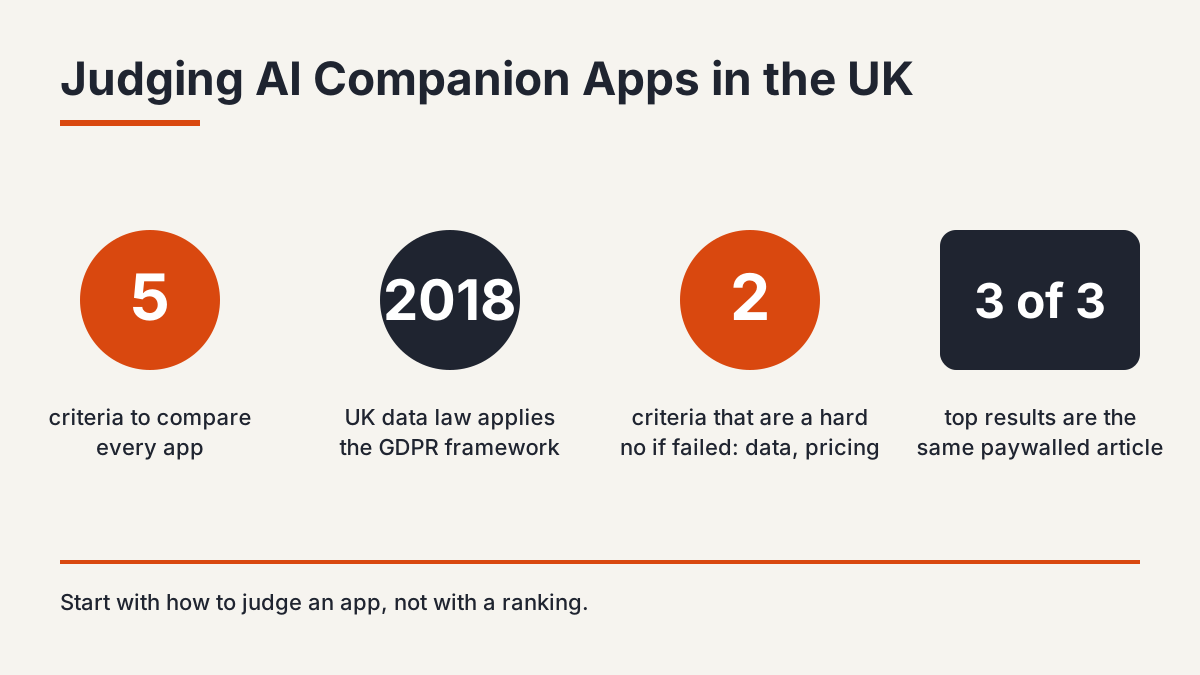
That variety is why headline rankings mislead. An app that suits someone wanting a daily check-in chat may be a poor fit for someone wanting structured roleplay. Before comparing anything, decide what you actually want from the product. Then compare apps on the same five criteria, described below, rather than on marketing claims.
DarLink Ai positions itself as an AI-powered platform offering various tools and services. Its public site is sparse on specifics, which is itself a data point. If you want the detail we do have, read our DarLink Ai review and the page on whether DarLink Ai is safe.
The five criteria that separate good apps from bad ones
A data-driven comparison needs fixed criteria, applied the same way to each app. These five do most of the work for UK users.

- Data handling: a readable privacy policy, a named data controller, and a clear deletion route.
- Pricing transparency: the real monthly cost shown before payment, with no buried auto-renewal.
- Moderation: stated content rules that are applied consistently rather than changing without notice.
- Age assurance: some check beyond ticking a box, particularly for apps with romantic or adult themes.
- Support: a working contact route and a visible response commitment.
An app that fails the first two should be a hard no, however good the conversation feels. Memory and voice quality are real selling points, but they are secondary to knowing where your data goes and what you will be charged.
How UK rules shape what you should expect
UK users are covered by the UK GDPR and the Data Protection Act 2018. In practice, that gives you the right to ask what an app holds about you, to request deletion and to object to certain processing. A compliant provider names a controller, states a legal basis for processing and explains how long chats are retained. If an app cannot tell you these things in plain English, treat that as a risk assessment result, not a minor omission.
Consumer law matters too. Subscriptions sold to UK consumers should disclose price and renewal terms before you pay, and cancellation should not be harder than signing up. Many companion apps run weekly or monthly plans that renew automatically, so check the renewal date the same day you subscribe. We cover this for one platform in our guide to DarLink Ai subscription pricing.
One more nuance: the Online Safety Act has raised expectations around age checks for services carrying adult content. Apps differ widely in how seriously they take this. A product that lets anyone in after a single click is telling you something about its compliance culture.
What I learned comparing paid tools by method, not price
In February 2025 I reviewed a group of compliance tools aimed at GB organisations, priced from 85 pounds to 620 pounds per month. I built a comparison matrix covering transparency reporting, consumer impact scoring and risk assessment depth. The top tiers gave the strongest outputs, yet the mid-range option suited smaller teams best. Cost alone told me almost nothing about usefulness until I looked at how each tool reached its conclusions.
The same lesson applies to companion apps. A 20 pound monthly plan is not better than a 10 pound one just because it costs more. Ask what the extra money buys: longer memory, more messages, voice calls or simply fewer ads. If the answer is vague, the price is arbitrary. Write down the features you would use weekly and pay only for those.
Free versus paid: what you actually get
Free tiers exist, but they come with limits. Typical restrictions include a daily message cap, shorter memory, slower responses or locked persona options. A genuinely free AI app usually means a general assistant or an ad-supported companion, not a full-featured relationship product. If an app calls itself free and then asks for card details on the second screen, read the trial terms before continuing.
Paid plans make sense when you use the app most days and the features match your needs. They make little sense if you open it twice a month. A sensible approach is to test the free tier for a week, note which limits actually annoyed you, and upgrade only if the same limits keep blocking you. Set a calendar reminder for the renewal date the moment you subscribe.
The problem with unrestricted apps
Users often ask which AI is the most unrestricted. The framing deserves caution. Fewer content rules usually come with fewer safeguards on data, age and conduct, and these products tend to have the thinnest privacy documentation. Restrictions are not the enemy. Predictable, published rules let you know what the app will do, while sudden policy changes are what break the experience and the trust.
If you value freedom of conversation, favour apps that publish their rules and stick to them over apps that advertise having none. The first group gives you something you can rely on. The second group gives you a promise that is easy to withdraw.
Downsides to weigh before you download
Be honest about the costs. Emotional reliance is the first one: apps tuned for engagement can pull you into longer sessions than you intended. Switching cost is the second, because months of built-up memory do not transfer between services, so a shutdown or price rise leaves you starting over. Data exposure is the third, since intimate chats are sensitive, and a breach would be worse than a leaked shopping history.
For DarLink Ai specifically, the main limitation is how little the public site discloses. We found no stated headquarters, no founding year and no listed payment methods on the page we checked, so you cannot yet compare it properly against rivals. Treat that as a reason to read its terms closely and ask support direct questions before paying. Our page on whether DarLink Ai is legit sets out what to look for.
A simple way to choose in under an hour
Open three candidate apps. For each, spend ten minutes reading the privacy policy and pricing page, then ten minutes in a free chat. Score every app from 1 to 5 on the five criteria above, and total the results. Drop any app that scores 1 on data handling or pricing, whatever its total. The winner is usually the app that is merely clear, not the one with the flashiest persona.
Revisit your choice after 30 days. Check your usage, your spending and how you feel after sessions. If the app has become something you open from habit rather than choice, that is a signal to cancel or switch. The best companion app is the one you control, not the one that controls your routine.
Comments
No comments yet.
Leave a comment
Your email will not be shown. Comments are reviewed before they appear.