


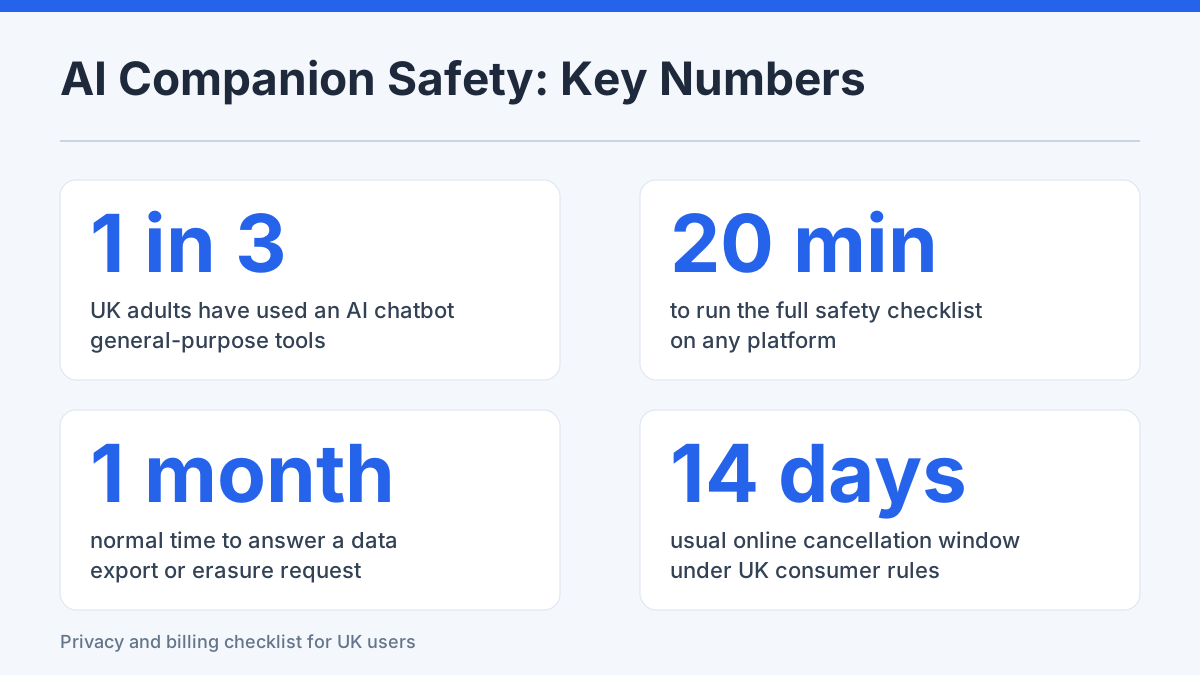
Roughly 1 in 3 UK adults now says it has used a general-purpose AI chatbot, and companion apps sit at the sensitive end of that trend. You share moods, habits and sometimes names with a service that bills you monthly. That mix of intimate data and recurring payments is why a safety check matters before you subscribe. The UK GDPR has applied since 2018, and it gives you real leverage, but only if you know what to ask.
This guide gives you a repeatable way to compare providers on privacy and billing. It is not a ranking of apps. It is a checklist you can run in about 20 minutes on any platform, including DarLink Ai, where public detail is thin and the checklist matters even more.
What "safe" actually means for an AI companion
Safe is not one property. It is four separate questions, and a platform can pass three and fail the fourth. First, data safety: what is collected, where it is stored, who can read it. Second, financial safety: how you are charged, how renewals work, how you stop paying. Third, content safety: age gating, moderation, and what the bot will say to a vulnerable person. Fourth, provider accountability: who is the legal entity, and where can you complain.
Most articles on this topic stop at generic advice such as "use a strong password" and "set emotional boundaries". That advice is fine, but it does not help you choose between two apps on the same afternoon. The sections below turn each question into something you can check on the provider's own pages, in your bank statement, and in the app settings.
One caution about public information. For some providers, including DarLink Ai, the official site describes an AI-powered platform offering tools and services without publishing a detailed pricing table, payout rules or company registration on the front page. Missing detail is itself a data point. Treat it as a reason to ask questions, not as proof of a problem.
Privacy: the five documents and settings to check
Start with the privacy notice, and read it for specifics. UK law requires a provider to state what personal data it collects, why, how long it keeps it, and who it shares it with. A notice that says "we may retain data as long as necessary" without a period is weaker than one that says "chat logs are deleted 30 days after account closure".
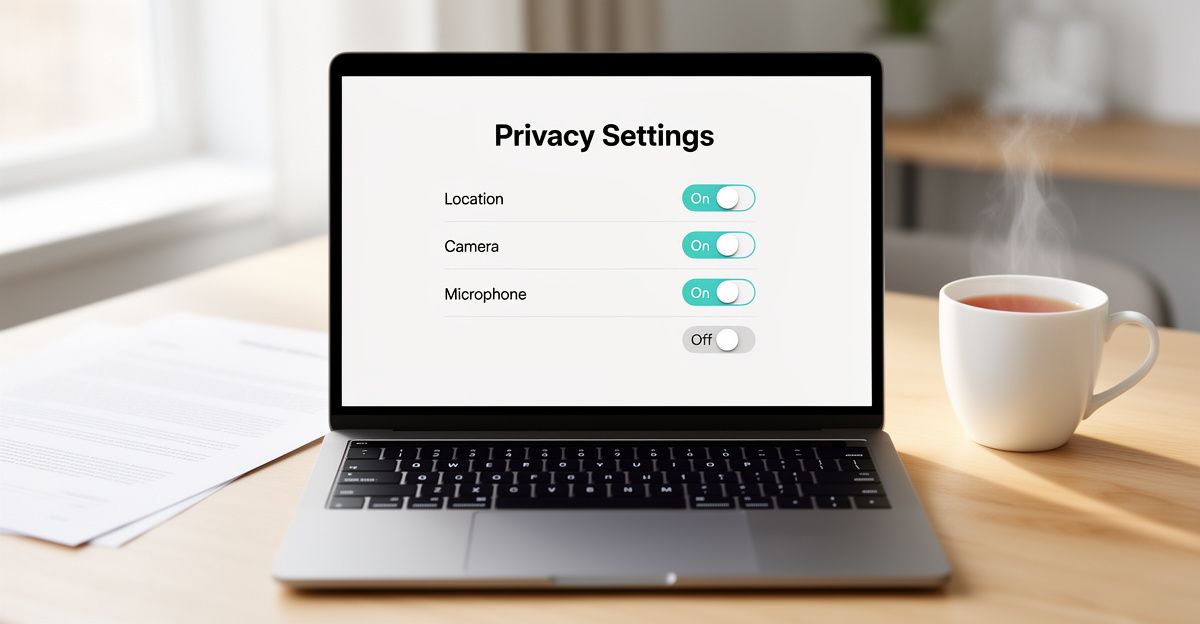
Run these five checks in order. Each takes a few minutes.
- Retention period for chat logs, stated in days or months, not left vague.
- A named legal entity and a contact address for data requests.
- Whether chats are used to train models, and whether you can opt out.
- A working account deletion route inside the app, not only by email.
- Where data is processed, and whether transfers outside the UK are covered by safeguards.
Then test the settings. Open the account page and look for export and delete options. Under UK GDPR you can request a copy of your data and ask for erasure, and the provider normally has one month to respond. If an app buries these rights or has no contact route at all, that is a practical red flag even before any legal argument.
A final privacy habit costs nothing. Do not give a companion app your full name, workplace, home address or financial details. A good platform does not need them, and a chat log you never typed cannot leak.
Billing: where most UK complaints actually start
In consumer disputes across digital subscriptions, the pattern is familiar: a low or free trial, an automatic renewal, and a cancellation path that takes five screens to find. The sector-wide complaint list for general consumer services includes unexpected charges, hidden fees and difficulty with returns, and companion apps are not exempt.
Before entering card details, find the answers to these questions on the checkout page itself. What is the price after any trial, in pounds, and is VAT included? Does the plan renew monthly or annually? Is there a credit or token system that charges extra for messages, images or voice? Can you cancel online in the same place you signed up?
Pay with a method that gives you recourse. A credit card brings Section 75 protection for purchases between 100 and 30,000 pounds in many cases, though small monthly fees often fall below that threshold. Debit card chargebacks and virtual cards with a spending cap are useful substitutes. A single-use virtual card set to the first month's price stops a surprise renewal outright, which is the most effective billing safeguard I know.
Under the Consumer Contracts Regulations 2013 you generally have a 14-day cancellation window for online purchases, but digital content can lose that right once you ask for immediate access. Read the checkout wording carefully, because a tick box there can waive it. If you are weighing the payment side of a specific service, the page on DarLink Ai payments is the place to compare what is listed against what checkout shows.
A procurement lens on a consumer product
I spent part of last October in Manchester at a product briefing for a compliance software package priced at 3,500 pounds a year for teams of up to ten users. The vendor claimed a 22 percent reduction in regulatory reporting errors, and I tested that against my own risk assessment criteria rather than accepting the slide. What impressed me was not the headline figure but the transparency: a daily-updating dashboard and documents I could verify.
That habit transfers directly to a 15 pound companion subscription. Ask the same blunt questions. Where is the evidence for the claim? What does the provider publish that I can check myself? Does the price I see match the price I pay? I would shortlist a business tool only after answering those, and I apply the same filter here. A consumer app deserves less money at risk, not less scrutiny.
Comparing platforms side by side
Once you have the facts for two or three providers, put them in one table. Do not rely on memory, because marketing pages are designed to blur the differences. Score each row yourself as clear, partial or missing.
| Check | What good looks like | What to treat as a warning |
|---|---|---|
| Retention period | Stated in days or months | "As long as necessary" only |
| Deletion | In-app button plus contact route | Email-only, no reply |
| Renewal | Price and date shown before payment | Trial converts silently |
| Cancellation | Same place as signup | Hidden in help pages |
| Company identity | Named entity and address | Brand name only |
A provider that scores "missing" on two or more rows is not necessarily unsafe, but it has not earned your card details yet. For a closer look at one provider's track record, the pages on whether DarLink Ai is legit and DarLink Ai complaints collect the questions worth asking before you commit.
Emotional and content safety in practice
Technical safety is only half of it. A companion that mirrors your mood can make a bad week feel worse if it agrees with everything you say. Skip any app that claims to replace therapy or a friend. The honest ones say they are entertainment or support tools and point to human help when you mention self-harm.
Look for age verification, a clear content policy and a way to report a conversation. If you are under 18, or choosing for someone who is, the bar rises sharply, and any platform without real age checks should be ruled out at once. Set a time limit too. Ten minutes in the evening is a very different pattern from three hours at 2am, and the second one is worth noticing in yourself.
Your 20-minute safety routine
Work through it once before paying, then again after your first month. In the first five minutes, find the privacy notice and note the retention period and the company name. In the next five, open the pricing or checkout page and write down the renewal price and cancellation route. Spend five minutes in the account settings testing export and delete. Use the last five to search the provider's name with the word "complaints" and read three recent results, weighing the dates.
Set a calendar reminder two days before any trial ends, and screenshot the checkout page so you hold a record of the terms you agreed to. If something goes wrong, you then have evidence for the provider, your card issuer and, if needed, the Information Commissioner's Office for data issues. Nothing in this routine needs technical skill, only the willingness to read before you click.
Comments
No comments yet.
Leave a comment
Your email will not be shown. Comments are reviewed before they appear.